The VP of Product came to the engineering leader with a verdict, not a question.
The CEO thought one engineering squad had barely delivered anything. The other squad, in his view, had delivered a lot. He was happy with one and disappointed in the other.
There was no report attached. No list of outcomes. No attempt to reconcile the roadmap, code history, and production before comparing the teams.
The VP did not defend the team. He passed the message to engineering.
And just like that, two squads were put into an arena they had never asked to enter.
One got the applause. The other got a trial. The engineering leader became its defence lawyer.
That should never have been part of the job. But doing nothing meant a capable team would be judged by a story that was both incomplete and wrong.
The verdict arrived before the evidence
Call them the Business squad and the Consumer squad. Those are not their real names, but the distinction matters.
The Business squad had delivered work leadership could easily see. There was a new dashboard. It had an audience. Someone could point at the screen and say, “There. That is what they built.”
The Consumer squad had spent much of the same period doing the sort of work that disappears when it succeeds.
They improved existing member journeys. They migrated old capabilities. They removed brittle manual steps. They replaced a legacy workflow where personal data was sitting somewhere it had no business sitting.
If they did that work well, users saw almost nothing. The capability existed before. It existed afterwards. The screen did not throw a parade because the risk behind it had been removed.
Migration has a nasty property: failure is highly visible; success looks like nothing happened.
One squad was praised. The other had to prove it existed
One squad had visible feature work. The other had continuity, quality of life improvements, cleanup, and risk reduction. Leadership turned those different portfolios into a horse race and announced the winner from the grandstand.
The squads had not chosen the race. The celebrated squad had done nothing wrong by shipping visible work. The accused squad had not failed because its work was harder to photograph.
But once the CEO’s view started travelling through the organisation, both teams were trapped by it. One became the benchmark. The other had to produce receipts after the verdict.
That is what weak delivery evidence does to people. It turns peers into rivals. It makes one team defensive and the other awkwardly overpraised. It encourages leaders to reward visibility instead of value.
Even the rough planning measures pointed in the opposite direction. Story points cannot declare a team “better,” but when a crude activity measure contradicts a confident leadership story, that is usually a good moment to stop talking and start checking.
Nobody had checked.
The search for the missing year
The engineering leader started with the work tracker. It contained most of the pieces, but not the story.
Tickets had been renamed. Epics had changed shape. Features had split into follow up work. Parent items stayed open after substantial child work was complete. Some urgent fixes had bypassed the planning hierarchy altogether.
If you looked only at the current board, the Consumer squad seemed fragmented and slow.
Git showed sustained implementation work: migrations, replacements, fixes, and follow up changes that no longer mapped neatly to the current ticket names. The code could show that something changed. It could not show why leadership should care.
Production showed capabilities still running on safer foundations. It showed improvements that had become normal so quickly that everyone had already forgotten the work behind them. It showed the result, but not the detours, scope changes, or risk retired along the way.
Jira showed one story. Git showed another. Production showed something else.
None of them was lying. None of them was enough.
When the three records were joined, the original assessment did not hold up.
The work existed. The evidence chain did not.
The CEO was wrong. The system helped him be wrong
There is a temptation to find a villain here. That would be convenient and dishonest.
The CEO was wrong. He turned a feeling about visible output into a judgment about a team. He should have asked for evidence before comparing people.
The VP was not malicious. But he acted as a relay when the team needed an evidence gate. He passed the verdict down instead of asking, “What supports this?”
The engineering leader was not blameless either. Explaining a year of work should never have required an emergency archaeology project.
Product could have written stronger closure summaries. Engineering could have connected risk reduction to business outcomes. The squads could have maintained cleaner links. Leadership could have asked better questions.
There was no single villain. There were several flawed humans, a reporting system built for next week, and one quiet team about to pay the price.
The feature everyone forgot
The most important work in the reconstruction was not a brand new feature. It was an existing capability moved away from a fragile, risky foundation.
The result users saw looked familiar. The operating reality underneath it was completely different. Leadership remembered the feature but forgot the delivery.
That does not make every migration valuable. Foundational work can overrun. Cleanup can stay open. A feature can be technically complete while lacking adoption, measurement, or operational ownership.
The answer is not to applaud all invisible work. The answer is to make it reconstructable.
- Show the continuity, customer improvement, risk reduction, and operating value created.
- Show the defects, cleanup, weak measurement, and remaining ownership.
Defending effort is not the goal. Reconstructing the outcome is.
The hidden cost was making a team defend itself
By the time the reconstruction was finished, there was enough evidence to challenge the CEO’s view and restore some fairness to the conversation.
But it should never have been necessary.
If the ducks had been in a row, the evidence would have existed before the accusation. The VP could have challenged the premise immediately. The CEO could have reviewed outcomes instead of impressions. The squad could have discussed remaining gaps without first proving it had been working.
Instead, the organisation paid for the delivery twice. First, engineers did the work. Then leadership paid for its engineering leader to excavate it.
The second bill was not just the leader’s time. It was trust.
Routine delivery evidence is the difference between a review and a trial.
A three record reconciliation
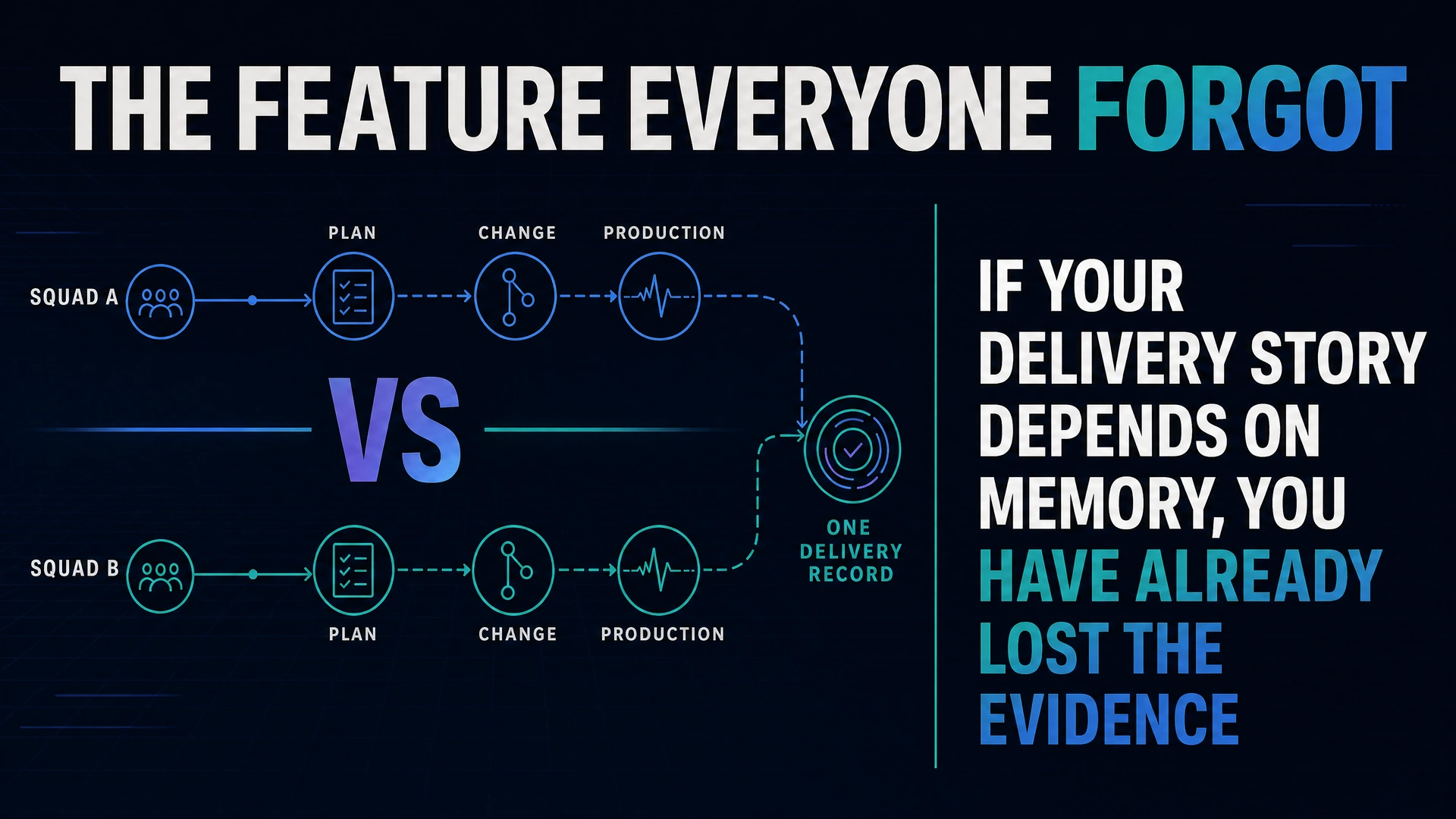
For every material initiative, reconcile three records: Plan, Change, and Production.
1. Plan: what did we think we were doing?
Record the stable outcome and owner, original scope, renames and splits, decisions that changed the intended outcome, and planned or unplanned work tied to the same initiative.
2. Change: what work actually happened?
Look for pull requests without a usable initiative link, migrations spread across planning items, hotfixes outside the roadmap, repeated changes in one capability area, and follow up defects belonging to an earlier decision.
3. Production: what is true now?
Record what users can do now, which dependency, manual process, or risk was retired, the acceptance evidence, remaining cleanup, and confidence in the account.
The seven question outcome note
The three records should converge into one short outcome note, not another dashboard that becomes background furniture.
- What stable outcome were we trying to create or preserve?
- How did the scope or identity of the work change?
- What planned and unplanned implementation evidence belongs to it?
- What production or acceptance evidence confirms the current state?
- What customer value, client value, or risk reduction did it create?
- What defects, cleanup, or measurement gaps remain?
- How confident are we, and what evidence is missing?
Refresh the note whenever an initiative is renamed, split, migrated, or materially changed. Require it before a large epic is treated as closed.
For agencies, the same note changes the client conversation. “The team was busy” becomes a bounded account of what changed, what shipped, what it cost, and what remains.
Ask better questions before choosing a winner
“Which squad delivered more?” is attractive because it promises a leaderboard. It is usually the wrong first question.
- Which customer or client outcomes changed?
- Which existing capabilities were preserved or made safer?
- Which risks, manual processes, or fragile dependencies were reduced?
- Which unplanned changes consumed capacity?
- Which initiatives are technically complete but not operationally closed?
- What evidence supports each answer, and where is confidence low?
The point is not to make every squad look successful. It is to stop choosing winners and losers from whoever has the most visible demo or the strongest memory.
Scopeworth is being built to turn fragmented delivery signals into client ready evidence. Not to rank developers. Not to manufacture a flattering story. To help delivery leaders reconstruct what changed, what shipped, what it cost, and how confident that account should be.
If your delivery story depends on memory, you have already lost the evidence.
And if a squad needs a defence lawyer before anyone asks for the receipts, you have probably lost something else too.